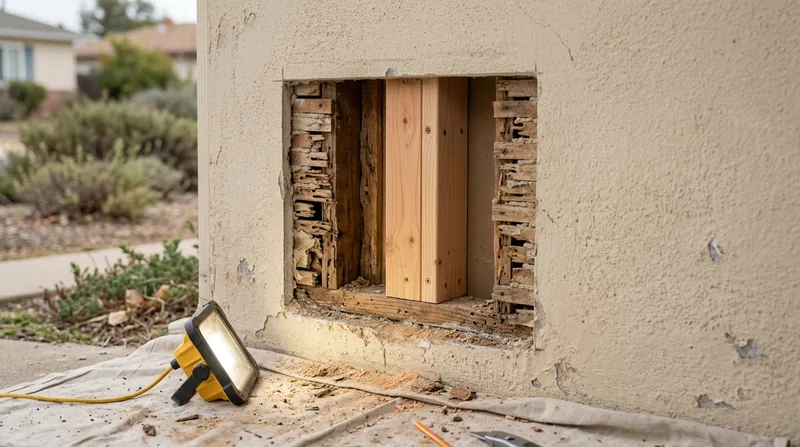




San Diego's Mediterranean climate and year-round warmth create ideal conditions for drywood termites to establish colonies and spread without seasonal die-off. Spanish Colonial Revival homes in Kensington, Mission Hills, and North Park often hide termite damage beneath cracking stucco, while craftsman bungalows in South Park and mid-century moderns in Clairemont face the same invisible threat. After your pest inspector identifies the damage, the structural work begins. We replace termite damage repair in studs, sill plates, floor joists, subfloor sections, rim joists, and exterior trim across San Diego residential properties, restoring full structural integrity where the wood justifies repair and replacing sections where it does not. This is where the exterminator's work ends and ours begins.
Why Termite Damage Repair Matters in San Diego's Residential Stock
Drywood termites do not require soil contact or high humidity. They establish colonies inside the wood itself, feeding from the inside out while leaving a thin outer shell intact. San Diego's frost-free climate means colonies active in spring remain active in November. The damage compounds silently: a sill plate weakens, a floor joist loses load capacity, a stud loses shear strength. Early repair stops the progression and preserves the framing. Delayed repair means replacement, which costs more and often requires permits.
- We remove termite-damaged studs and replace them in kind, restoring wall shear strength and plumb.
- We sister or replace compromised floor joists and subfloor sections to restore load capacity and eliminate deflection.
- We repair or replace sill plates and rim joists to restore the connection between wood frame and foundation.
- We replace damaged exterior trim, fascia, and soffit sections to stop moisture entry and prevent further colony establishment.
Catching damage early and acting on your pest inspection report keeps repair costs proportional to the scope of actual wood loss.
Key info: Drywood termites thrive in San Diego year-round because our mild winters never kill active colonies. A home in Pacific Beach, Ocean Beach, or inland areas like Rancho Bernardo faces equal risk. The cracking stucco common on Spanish Colonial Revival homes often hides the damage underneath until it's advanced. Have your inspector document exact locations and severity, then call us with that report in hand.
For more context on wood damage assessment and repair strategy, see our wood rot and dry rot repair page, which covers similar pathology and repair logic.
The California Department of Consumer Affairs publishes guidance on contractor licensing and dispute resolution. You can verify contractor credentials at cslb.ca.gov, the official Contractors State License Board website.
How We Handle Termite Damage Repair in San Diego Homes
We start with your pest inspection report. That document tells us exactly where termites fed, how deep the damage runs, and which structural members are compromised. We inspect those zones in person, probe the wood with hand tools to assess fiber integrity, and determine whether each damaged section can be repaired or must be replaced. Repair means sistering a new joist alongside the old, or filling localized voids and reinforcing with epoxy or dutchman patches. Replacement means removing the damaged member, installing new framing in the same species and dimension, and restoring connections to adjacent framing.
- We inspect and document the damage in writing, with photographs, before proposing work.
- We source dimensional lumber matching the original species, size, and grade whenever replacement is needed.
- We remove damaged sections cleanly, making square cuts perpendicular to grain for strong epoxy joints or dutchman patches.
- We install new framing, sistered joists, or repair patches with fastening and glue rated for the structural role that member plays.
- We verify that all connections, bearing points, and load paths are restored and tight.
The goal is a frame that performs as it did when first built, with no soft spots, no settlement, and no future surprises.
Local example: A 1950s craftsman bungalow in Golden Hill had termites in the rim joist and two floor joists under the kitchen. The pest report identified the exact bays. We removed the damaged rim joist section, installed new pressure-treated rim joist, and sistered the two floor joists with new Douglas fir joists bolted and glued. The floor no longer bounces, and the kitchen is solid again. Total time: 3 days.
For larger structural issues involving multiple joists or load-bearing walls, see our page on floor joist and subfloor repair.
Repair Methods and Approaches for Termite-Damaged Framing
| Approach | Description | Best for |
|---|---|---|
| Dutchman or epoxy patch | Small localized voids filled with epoxy or wooden dutchman patches glued and fastened into place. | Shallow damage in trim, fascia, or non-critical framing where the member retains most of its cross-section. |
| Sistering | A new joist or stud bolted and glued alongside the damaged member, sharing the load and restoring capacity. | Floor joists or studs where damage is moderate and the original member is still in place and bearing. |
| Section replacement | Removing the damaged section of a joist, rim joist, or sill plate and installing a new section spliced with bolts and glue. | Damage confined to one end of a joist or a short run of rim joist, where the rest of the member is sound. |
| Full member replacement | Removing the entire damaged joist, stud, or sill and installing a new member of the same species, size, and grade. | Severe damage across the full length of a member, or where repair would not restore adequate strength or safety. |
Each approach is chosen based on the location of damage, the structural role of that member, and the economics of repair versus replacement. We always choose repair when the wood justifies it.
Termite Damage Repair Cost in San Diego: What to Expect
Termite damage repair starts at around $1,200 for small, localized damage in trim or a single joist section. That covers inspection, documentation, removal of the damaged piece, sourcing and installation of replacement material, and finishing. Cost rises with the number of damaged members, the depth of the damage, the complexity of access, and whether the work touches load-bearing framing. A rim joist repair in a raised-foundation home in Clairemont might cost $2,800 to $4,500 depending on the length of damage and whether the entire rim needs replacement or just a section. Damage to multiple floor joists under a kitchen can run $3,500 to $6,000 or more.
The best way to know your actual cost is to have your pest inspector's report in hand, call us at (619) 815-5154, and schedule a free on-site estimate. We inspect the damage, measure the scope, and give you a firm price before we start. Getting 2 or 3 estimates is smart practice. Compare what each carpenter proposes to repair, what each proposes to replace, and why.
For a detailed pricing overview and examples of common jobs, see our full pricing page.
Termite Damage Repair Near Me: What San Diego Homeowners Should Know When Hiring
When you call a carpenter for termite damage repair, ask whether they have experience with the specific members you need repaired: sill plates, rim joists, floor joists, studs, or exterior trim. Ask how they propose to repair versus replace each damaged section, and why. A carpenter who automatically replaces everything is padding the bill. A carpenter who repairs everything without assessing the actual depth of damage is cutting corners. You want someone who explains the pathology, shows you the damaged wood, and justifies each repair choice.
Verify that the carpenter is fully insured for general liability and workers' compensation. Ask for references from recent jobs in San Diego, Chula Vista, or nearby areas. If the work involves removing or altering studs in a load-bearing wall, or if it requires removing a load-bearing header, check with your local building department to understand whether a permit is required. Permit thresholds and scope rules vary, so verify the rules for your neighborhood before work begins. If you have an HOA, check the covenants to see whether the work requires architectural approval.
Get a written estimate that details what will be removed, what will be installed, what materials will be used, and what the price is. Do not accept a verbal estimate or a vague proposal. Call us at (619) 815-5154 or visit our contact page to schedule your free estimate.
Termite Damage Repair in San Diego: Pricing Guide
| Service | Price | Details |
|---|---|---|
| Small trim or fascia repair | Starting at $1,200 | Localized termite damage in exterior trim, fascia, or soffit; dutchman patches or small section replacement included |
| Single joist or stud repair | Starting at $2,200 | One floor joist sistered or partially replaced, or one stud replaced in non-load-bearing wall; includes removal and new framing |
| Rim joist or sill plate repair | Starting at $2,800 | Damage to rim joist or sill plate under raised foundation or crawlspace; cost varies by damage length and whether section or full replacement |
| Multiple joists or structural members | On estimate | Damage across multiple joists, subfloor sections, or load-bearing framing requires on-site inspection to assess scope and determine exact cost |
| Travel and estimate | Free estimate | No charge for inspection and written proposal; travel included in San Diego and surrounding service areas; response within 24 hours |
Indicative pricing, the exact cost depends on square footage, finish, and site access. Free personalized estimate within 24h at (619) 815-5154.


